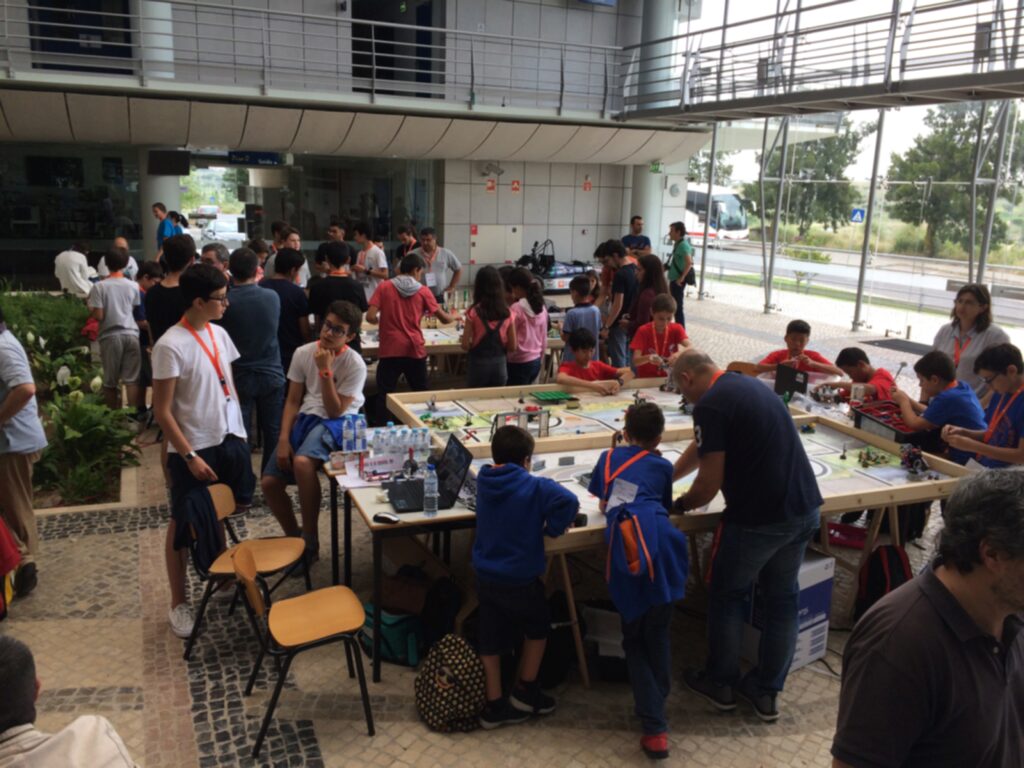
I will explain the dynamics around the program and at the end, how most of the judges struggle with the counter-intuitive alignment of the short-term goals (awarding) with the long-term goals (getting a generation of children excited with STEM). Every once in a while, I have a glimpse of what it means to fulfill the long-term goals, by having a skinny 13 years old girl with shining eyes turn to me and say: “I found out, I love programming!” while she frenetically moves her arms.
The tournament
A new worldwide challenge theme is picked every year on present-day issues like climate changes, senior solutions, food distribution chain, etc. A tournament is a one-day event where every team will have the opportunity to show what they have done during the season, namely: Robot Design, the techniques used in building the robot to ensure, speed, accuracy, extensibility, etc; Mission execution (three rounds), the performance of the robot in accomplishing the missions included in the challenge in only two and half minutes; The project, a project according to the theme with social impact, that identifies a problem, develops an innovative solution and shares with others. Core Values, a set of values that transcend competing and should guide everyone involved, these values help us focus on the long term goals.
The Team
A team is a group of 2 to 10 kids with ages that range from 9 to 16 years, supported by a coach and/or mentor. Being a judge since 2008, I have identified several team archetypes that bring a lot of diversity and color to the competition: Company sponsored team - some teams are sponsored by companies that partner with FLL. They tend to include employees as coaches or mentors and sons and daughters as team members. These teams have dedicated new robot kits(EV3) but usually, find it hard to schedule the time to prepare for the competition. They also tend to have a clearer team identity. Top private schools with a robotics program - these schools tend to be very well prepared, have a regular robotics program which includes participation in multiple competitions. Professors are coaches. Very good labs with lots of new robot kits (EV3). These teams usually perform well at the tournament in spite of having a shorter preparation time window. Additional internal competition is also a trait. Public schools (urban and rural) - usually, have robotics within an extra-curricular activity club. Tends to depend greatly on the sweat and inspiration of a teacher and not a school strategy. Financial support comes from sponsors and/or school limited budget. Access to robots is shared and limited and outdated (RCX and NXT). Extra access time tends to build up as the competition date approaches, via allocation of lunch time and free time.
Just to help put things in perspective, there are teams that wake up at 5 am to drive 400 kilometers and others who fly 1500 km, just to get to the tournament. Onsite, one finds out that 1 team member, that worked hard all season for that moment, is missing because he has chores on the family farm during weekends.
The Core Values
The core values are the heart of FLL and are expected to be the guiding light of every participant in the tournament:
- We are a team
- We do the work to find solutions with guidance from our coaches and mentors.
- We know our coaches and mentors don’t have all the answers; we learn together.
- We honor the spirit of friendly competition.
- What we discover is more important than what we win.
- We share our experiences with others.
- We display Gracious Professionalism® and Coopertition® in everything we do.
- We have FUN!
When Meritocracy fails miserably
At the end of the tournament, the scoring takes place and the awards are distributed amongst the teams. Aligned with the FLL core values two rules support this process:
- For a team to be considered for an award, they should be evaluated at an Exemplary level of achievement in that category whenever possible.
- Awards distribution is spread as equitably as possible among the teams, with the goal of no team winning more than one judged award.
This is where it gets trickier. Every time, I find advocators of the Meritocracy system. Somehow these colleagues have been trained in the harsh reality that only the best succeed and the only fair option, for them, is to award all the prizes to the best teams. I relentlessly disagree. That is neither the spirit of the tournament with its core values, the pedagogical recommendation nor the award rules. Some kids are awesome they are able to accomplish so much and have fun watching the fruits of their work and dedication. However, the disparity of the conditions of some of the teams is so huge, that, some other kids will have weak mission results and feel bad about it. And, I am not willing to lose another opportunity of getting kids excited with STEM.
I find it shortsighted to focus on the immediate reward. The real long term goal is to motivate kids with fewer opportunities, so that, if they set their mind to it, they will excel.
If with 1 hour a week of access to a robot I got the “Inspiration Award” imagine what I could do next year with all the accumulated experience from this year.
I was once asked if by leaving the “core values” awards for last meant I did not believe in its importance? After all, I am a core values judge. I regret not answering appropriately at that time. But I guess I can do it right now. It is actually quite the opposite. All the top teams, got there because they are already mostly doing it right, able to work as a team, respect the other team members, having fun, discovering themselves, etc. As a result, they have better results. The true realization of the “core values” is when you motivate weaker teams that somehow feel the joy of building robots also but show lesser results for many external reasons.
The WOW! Moment
My WOW! Moment happens when a team arrives late at the tournament because the school made a detour to allow some of the kids to see the sea for the first time. Being a part of something that creates this possibility and associates STEM to such powerful emotions is why I come back every year. That night when these kids fall sleep they will be dreaming of waves and building robots. And I will know that a bright future lies ahead for all of us.